Tank Mixing Order, Step by Step
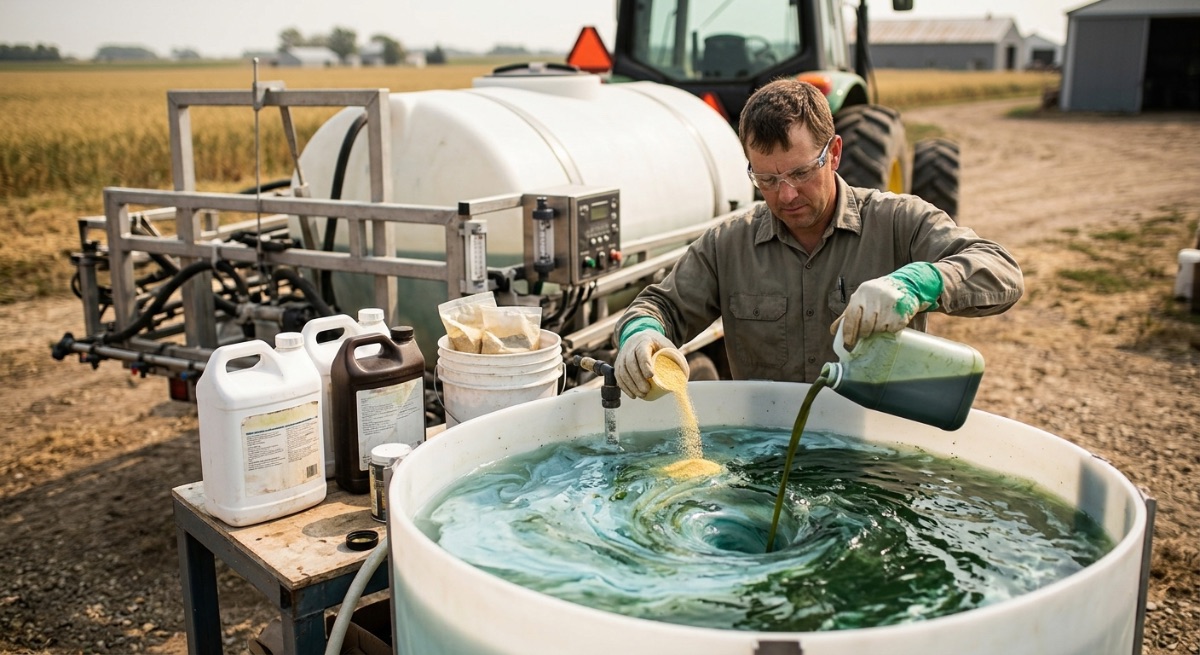
There is a line that recurs in extension guides and is worth taking seriously: most of the physical incompatibility seen in the tank does not come from the products being incompatible with each other, but from them going in in the wrong sequence. The same two products, loaded in the right order with agitation between each one, mix clean.
Which means mixing order is not an inherited ritual. It is the variable that decides whether the load you just prepared gets sprayed or dumped.
Why the order matters physically
Each formulation type arrives at the tank in a different state and needs something different from the water.
A water-dispersible granule or a wettable powder is a solid that has to be wetted and dispersed particle by particle. It needs plenty of free water and agitation. If it goes into a tank that already holds an emulsifiable concentrate, it meets an oily phase that coats it before the water can wet it: it cakes, it forms lumps, and those lumps will not break up no matter how long you agitate.
An emulsifiable concentrate is the opposite: oil that needs to disperse as fine droplets throughout the volume. If it goes in when the tank is nearly empty, or when the water is already loaded with suspended solids, it emulsifies poorly and ends up as a layer on top.
A surfactant lowers the surface tension of everything it touches. If it goes in first, the mix foams under agitation, and foam displaces useful volume, trips the fill valve early and leaves you with an incomplete load that does not match your rate.
The sequence exists so each formulation finds the environment it needs when its turn comes.
The sequence, step by step
The most widespread mnemonic is W-A-L-E-S — water, agitate, liquids, emulsifiables, surfactants. It works as a skeleton. In practice it is worth breaking down further:
- Water: fill between half and three quarters of the tank. Do not fill to the top: you need free volume for each product to disperse before the next one goes in, and for container rinse water.
- Start the agitation and do not stop it. The whole sequence happens with the tank agitating. Adding a product to a still tank and agitating afterwards is one of the most common ways to manufacture lumps.
- Water conditioners. If your water is hard or alkaline, the conditioner goes in before the products, not after — its job is to prepare the water, and it arrives too late if the herbicide is already in.
- Water-soluble bags. They go in whole and need time to dissolve completely before anything else. No exceptions: half a dissolved bag is half a dose.
- Solids: dispersible granules and wettable powders. Slowly, letting each one disperse. Making a pre-slurry in a bucket of water helps a lot.
- Suspension concentrates and flowables. They arrive already in water, but they are suspended solids: after the dry products and before anything oily.
- Soluble solutions.
- Emulsifiable concentrates and oils. Near the end, tank fairly full and agitating.
- Surfactants, adjuvants and defoamers: always last.
- Top up the volume with the remaining water, agitating.
The label rules. When a product label specifies a mixing order, that order takes precedence over any general rule. If two labels contradict each other, that contradiction is exactly the case where a jar test is worth doing before committing a whole load.
The rules that go with the sequence
Never concentrate onto concentrate
Every product enters the tank diluted in water or falls onto moving water. Pouring one product directly onto another undiluted is the fastest recipe for a reaction that will not undo.
One product at a time, and wait
Let each one incorporate fully before the next. Hurrying here does not save time: it costs triple if you have to dump and rinse.
Rinse the containers and add the rinsate to the tank
Triple rinse: you recover product you already paid for, and you leave the container fit for safe disposal.
Cold water costs you
Solids dissolve more slowly in cold water. On cold mornings, more agitation time per product — or you will be spraying lumps you cannot see.
A prepared mix does not keep
A load that sits overnight in the tank can separate, settle or degrade chemically even if it mixed perfectly. If you have to stop, leave the agitation running or empty out. And when you resume, check before spraying.
How this breaks in a real operation
The order lives with whoever mixes. The problem shows up when that person changes: a new helper, a day when the usual operator is on another field, a mix prepared only twice a year that nobody quite remembers.
That is why the sequence should not live in one person's head. Each job's mix — which products, at which rates, in which order — belongs on the work order, just like the hectares and the rate. Written once, anyone can repeat it.
In short: water to half a load, agitation from the start, conditioner before anything, solids before liquids, emulsifiables near the end and surfactant last. The label beats the general rule, and the jar test settles the doubts. The sequence is not superstition: it is the order in which each formulation can do what it needs to do.
General guidance only. Always follow the product label and consult a licensed agronomist or extension specialist for your products and conditions.
Sources: University of Nebraska-Lincoln Extension; Penn State Extension; Montana State University Pesticide Education Program; University of Arkansas Cooperative Extension.